
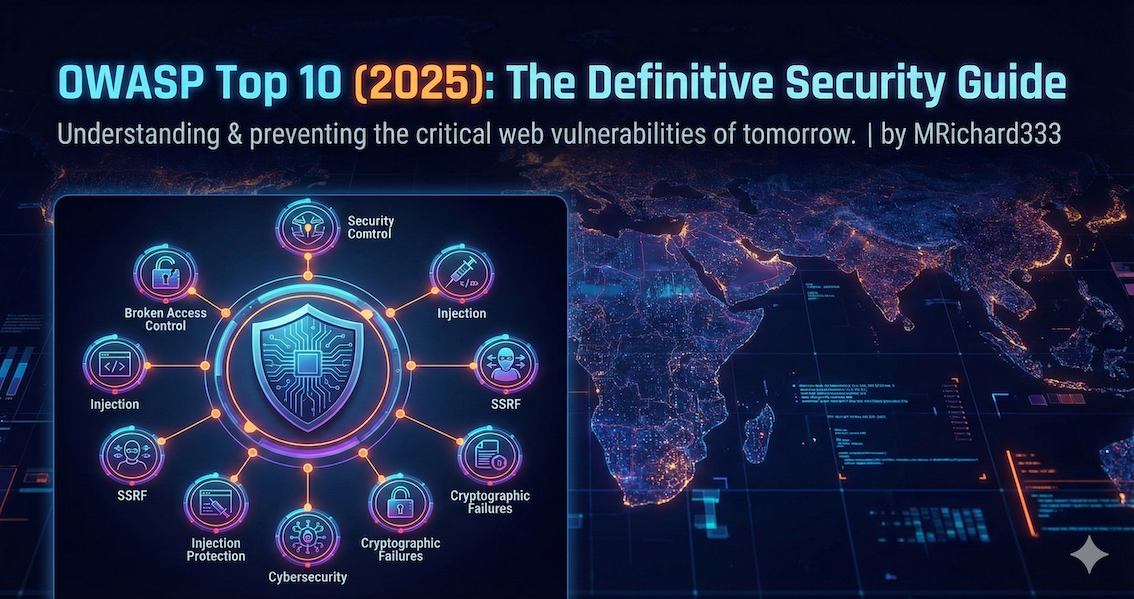
Understanding and Preventing Common Web Vulnerabilities
OWASP Top 10 Web Security Risks in 2025 — Complete Guide
In the rapidly evolving landscape of web development and cybersecurity, staying ahead of vulnerabilities is crucial to protect your applications and users. The OWASP (Open Web Application Security Project) Top 10 is a globally recognized list that highlights the most critical security risks for web applications. Updated regularly, the 2025 list reflects emerging threats and modern attack vectors.
This comprehensive guide explores the OWASP Top 10 web vulnerabilities you must understand in 2025 — along with practical prevention strategies to secure your apps, APIs, and web services.
What is OWASP Top 10?
OWASP Top 10 is a standard awareness document for developers and security professionals. It serves as a baseline for secure coding and risk management by listing the most frequent and severe security risks in web apps.
Key Insight: The 2025 list adapts to new technologies, cloud-native architectures, and advanced attacker techniques. Understanding these vulnerabilities is the first step toward building secure applications that protect user data and maintain trust.
OWASP Top 10 Web Vulnerabilities in 2025
Broken Access Control
What it is: Improper enforcement of permissions allows attackers to access unauthorized resources or perform restricted actions.
Example: A user manipulating URLs or API requests to access data or functions they shouldn't have permission for, such as changing a URL parameter from /user/123 to /user/124 to view another user's account.
How to prevent:
- Enforce access control checks on the server side, not just client-side
- Use Role-Based Access Control (RBAC) or Attribute-Based Access Control (ABAC)
- Implement consistent authorization logic for all endpoints and APIs
- Employ security testing (automated and manual) to validate permissions
Cryptographic Failures
What it is: Weak or incorrect encryption practices that expose sensitive data to interception or tampering.
Example: Using outdated hashing algorithms (like MD5 or SHA-1), or transmitting sensitive information over unencrypted HTTP connections, leaving passwords and credit card data vulnerable to man-in-the-middle attacks.
How to prevent:
- Use strong, modern encryption standards (e.g., AES-256, SHA-3)
- Always use HTTPS/TLS with up-to-date certificates
- Protect encryption keys securely (hardware security modules or vaults)
- Avoid storing sensitive data unless necessary; use tokenization where possible
Injection
What it is: Untrusted input is sent to an interpreter (SQL, NoSQL, OS, LDAP, etc.) causing unintended commands execution.
Example: SQL Injection where an attacker manipulates queries to extract or modify database data. For instance, entering ' OR '1'='1 in a login form to bypass authentication.
How to prevent:
- Use parameterized queries or prepared statements for databases
- Sanitize and validate all user inputs rigorously
- Employ ORM libraries with built-in protections
- Implement Web Application Firewalls (WAFs) to detect and block injection attempts
Insecure Design
What it is: Security weaknesses rooted in poor design decisions, not just coding errors.
Example: Lack of threat modeling or failure to implement security controls during design phases, such as building a banking application without considering rate limiting on money transfers.
How to prevent:
- Adopt Secure Development Lifecycle (SDL) practices
- Perform threat modeling early and continuously
- Use secure design patterns and frameworks
- Regularly review architecture for security gaps
Security Misconfiguration
What it is: Misconfigured servers, frameworks, or cloud services expose vulnerabilities.
Example: Default credentials left unchanged, unnecessary services enabled, or verbose error messages leaking sensitive information about the application's technology stack.
How to prevent:
- Harden server and application configurations (disable unused ports, services)
- Change default passwords and keys immediately
- Automate configuration management and deployment with security in mind
- Regularly audit your configurations and apply patches promptly
Vulnerable and Outdated Components
What it is: Using libraries, frameworks, or software with known vulnerabilities.
Example: Running outdated CMS plugins or JavaScript libraries that attackers exploit using publicly available exploits, such as using an old version of Log4j with known remote code execution vulnerabilities.
How to prevent:
- Keep all dependencies up to date with security patches
- Use tools like Dependabot or Snyk to monitor and alert on vulnerabilities
- Remove unused or unnecessary components from your stack
- Prefer well-maintained open-source libraries with active communities
Identification and Authentication Failures
What it is: Weak authentication or session management leading to account compromise.
Example: Poor password policies, no multi-factor authentication (MFA), or insecure session tokens that allow attackers to hijack user sessions or brute-force weak passwords.
How to prevent:
- Implement MFA for all user and admin accounts
- Enforce strong password policies and hashing (bcrypt, Argon2)
- Use secure, HTTP-only, and same-site cookies for session management
- Invalidate sessions after logout or inactivity
Software and Data Integrity Failures
What it is: Failure to protect code and data from unauthorized changes or tampering.
Example: Accepting unverified software updates or relying on unsigned packages, allowing attackers to inject malicious code into your CI/CD pipeline or supply chain.
How to prevent:
- Use code signing and integrity verification for updates
- Protect CI/CD pipelines and deployment workflows
- Monitor file integrity and audit logs continuously
- Employ Content Security Policy (CSP) headers to prevent injection of malicious scripts
Security Logging and Monitoring Failures
What it is: Lack of sufficient logging or monitoring to detect and respond to attacks.
Example: A breach occurs where attackers scan ports and brute-force APIs for days. Because the application logs are not monitored or triggered alerts, the breach is only discovered months later by a third party.
How to prevent:
- Ensure all login, access control, and server-side input validation failures are logged
- Establish effective monitoring and alerting (e.g., SIEM tools)
- Adopt an incident response plan to cope with attacks in real-time
- Protect logs from tampering or unauthorized access
Server-Side Request Forgery (SSRF)
What it is: An attacker forces the server to make requests to unintended locations, often to access internal services or metadata behind the firewall.
Example: A web app allows users to upload a profile picture via URL. An attacker enters a URL like http://169.254.169.254/ (AWS metadata service) to steal cloud credentials or map the internal network.
How to prevent:
- Validate and sanitize all user-supplied URL inputs
- Use an allowlist of permitted domains and protocols
- Disable HTTP redirections on the server-side HTTP client
- Segment remote resource access functionality in a separate network layer
Key Pillars of Modern Defense
Securing against the OWASP Top 10 requires a shift in mindset. Here are the core strategies to adopt in 2025.
Zero Trust Architecture
Never trust, always verify. Assume the network is hostile and authenticate every request, regardless of origin.
Shift Left
Integrate security early in the development lifecycle (DevSecOps) rather than testing only before deployment.
Defense in Depth
Layered security controls (WAF, encryption, MFA, logging) ensure that if one fails, others are in place to stop the attack.
Pro Tip: Automation is your friend. Manual code reviews are essential, but automated SAST (Static Application Security Testing) and DAST (Dynamic Application Security Testing) tools are necessary to scale security in 2025.
Essential Resources
Secure Your Application Today
Don't wait for a breach to prioritize security. Start with a comprehensive audit of your current stack against these 10 vulnerabilities.
Enjoyed this article?
Support the author — leave a quick review.
★ Make a ReviewRead our other articles


MRichard333
We believe that everyone should have the right to have a Peaceful online experience without any inconvenience or stress,
We Strive to offer you the best experience and satisfaction!

Subscribe to our Newsletters
to stay updated on our
upcoming Courses,
Major Project and more.


©2019 - 2026 MRichard333.com All Right Reserved

Dedicated to cybersecurity and fraud prevention.
Featuring: Scanner, Articles & ToolsPrivacy & Cookies
We use functional and analytics cookies to improve your experience. By continuing, you agree to our Terms of Service and Privacy Policy.